 Thought Leadership
Bethpage Black and the Shadow of Robert Moses
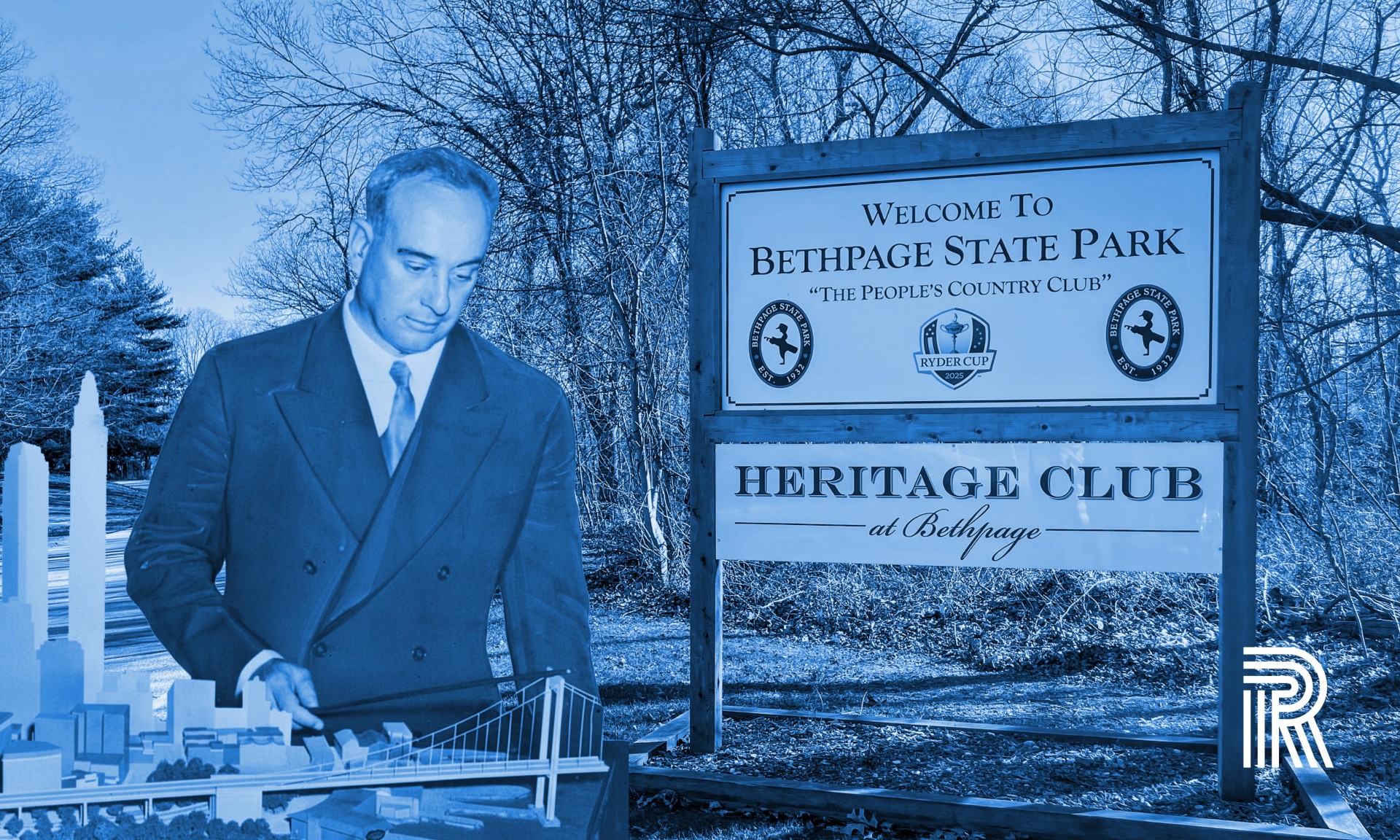
When the Ryder Cup comes to Bethpage Black this week, it will be more than a showcase of sporting skill and nerve. For those of us who study reputation, power and influence, it is also a reminder of the formidable legacy of Robert Moses. Bethpage State Park endures as one of his many striking monuments: a vast, high-quality public space that is rare in the American landscape. Elite in its design yet democratic in its access, it offers world-class golf alongside hiking trails, polo grounds, and playing fields. Open to all, Bethpage was conceived to rival the most exclusive private country clubs, and it still does.
I just finished Robert A. Caro’s The Power Broker, the Pulitzer Prize–winning biography of Robert Moses. Despite its subject, it has rightly earned a reputation as one of the greatest biographies ever written. First published in 1974, Barack Obama read it aged 22 and was “mesmerised”, an early lesson in the realities of power that helped shape a future President.
Moses reshaped New York on a scale few leaders ever could, driving the creation of hundreds of miles of parkways, bridges, tunnels, beaches, and state parks, including Bethpage. His imprint extended from Jones Beach to the Triborough Bridge, from massive public housing projects to Lincoln Center. By building places like Bethpage State Park, he amassed a level of power and reputation that rivalled and often outstripped elected politicians.
Bethpage: An Unusual Public Masterpiece
The land that became Bethpage was once a private estate, owned by Benjamin Franklin Yoakum. In 1931 the state under Moses leased the golf club; by 1934 the state purchased the land, and by 1936 multiple golf courses (Green, Blue, Red, Black) were opened to the public under Moses’ direction. Designed by architects including A. W. Tillinghast and Alfred Tull, the courses among Bethpage’s five are laid out so that they challenge experienced golfers while also being accessible. But what really sets Bethpage (especially Bethpage Black) apart is its public ownership and operation. In the United States most championship-level golf courses are private or semi-private. Bethpage Black has hosted major championships; the U.S. Open, the PGA Championship despite being a state park. That is rare.
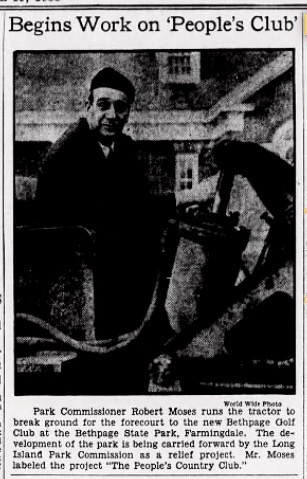
The park is not just golf. It offers fields, trails, picnic areas, tennis courts and even polo fields. It is both civic amenity and a sporting stage. The parkways built to reach it were meant to resemble rustic, pleasant travel ways not raw highways. Moses frequently designed parkways to preserve scenic character, sometimes using wooden lights, stone-faced overpasses, restricting commercial traffic. All this to enhance the reputation both of the place and indeed of Moses himself.
Building Reputation Through Relationships and Accomplishment
Moses understood that building big infrastructure or public works was not enough. Reputation comes through relationships with elected officials, with funding authorities, with the media, with architects and with influential citizens. His early alliances with Long Island State Park Commission, with governors and mayors, allowed him to leverage stimulus funds during the Great Depression to build massive public works including the Bethpage park courses and the roads and parkways to connect them. The combination of visible results and powerful allies allowed him to accumulate extraordinary informal power.
Moses cultivated the appearance of being above politics. He refused salary for some positions, emphasised technical competence, presented himself as a visionary for the public good. This enhanced his reputation as someone who got things done, not mired in petty partisanship. Moses benefited enormously from media support. Newspapers, magazines, public broadcasts amplified his projects, presented them as both modern and democratic. His ability to tell a story about what New York could become was as important as the roads or parks themselves.
The Turning Point: Arrogance, Complacency and Enemies
But reputation, like infrastructure, requires constant maintenance. Alfred E. Smith, the former New York governor and four-time presidential candidate who first elevated Moses into public service, once warned Moses that “the crowd is with you today and against you tomorrow” a lesson Moses never fully heeded. He made enemies by treating political leaders as interchangeable with their predecessors, presuming loyalties would carry forward. When governors and mayors changed, he often assumed they would defer to his legacy rather than assert their own agendas. That assumption worked, until it didn’t.
Over time, he grew increasingly isolated from the very people he was supposed to serve. He lost the common touch and the sharp instinct for working with, through and often around others that had once propelled him forward. Communities displaced by his expressways no longer accepted it as progress. Allegations of racism, from the design of low bridges that kept buses from reaching Long Island beaches to the siting of projects that hollowed out minority neighbourhoods, hardened opposition. What had once seemed monumental and visionary in the 1930s and 1940s appeared, by the 1960s and 1970s, arrogant and oppressive.
Caro shows how Moses’s disdain for dissent, his disregard for minority communities and his prioritisation of cars over public transit produced mounting backlash. His arrogance alienated potential allies, and his belief that his reputation was untouchable blinded him to growing criticism. When accused of destroying communities, Moses would double down, presenting the backlash as proof of the scale of his vision. He argued that any project of consequence would inevitably displace someone, and that listening too closely to complaints would only mean bowing to a different set of naysayers.

“I raise my stein to the builder who can remove ghettoes without moving people,” he declared, “as I hail the chef who can make omelettes without breaking eggs.”
This line captures Moses’s belief that disruption was the price of progress and that his belief that reputation only grew stronger when challenged.
Reputation in Motion
Moses was once admired as the master builder, his reputation forged by the parks, bridges, parkways and beaches that seemed to embody public purpose on a grand scale. Bethpage, Jones Beach and a vast network of public amenities made him appear indispensable, a man whose ability to deliver reshaped New York. But by the time Robert Caro published The Power Broker in 1974 that reputation had been reinterpreted. Moses emerged as an unchecked autocrat, his achievements weighed against the displacement of communities, environmental damage, inequities of access and the social costs of his decisions.
Relationships that had once amplified Moses’s power were later recast as evidence of overreach and arrogance. By 2025 his reputation remains unsettled, but reputation can be like a pendulum. It is not hard to imagine Moses being reinterpreted again. After all, the bridges, tunnels, expressways, parks, and beaches he built; Jones Beach, the Triborough Bridge, the Verrazzano-Narrows, the parkways, Lincoln Center and Bethpage. His achievements still define how millions of people live and move through New York. Bethpage in particular remains a jewel: a democratic space of world-class quality that now hosts global sporting spectacles.
And yet the criticisms Caro brought to light still resonate: inequity of access, displacement, environmental damage the arrogance of sidelining local voices. Moses is at once admired and admonished, his reputation oscillating between awe at what he achieved and anger at how he achieved it. Perhaps there is also a harder truth here; that societies sometimes need one person with the vision and raw power to cut through inertia and deliver. Committees often debate endlessly; consensus can delay, dilute, or kill ambition. Moses showed both the brilliance and the danger of that model. He endures as a builder whose monuments remain, and as a cautionary reminder of reputation’s fragility, its tendency to rise and fall, and its certainty to be reinterpreted again.
Legacy is never fixed. What one generation hails as triumph, another may condemn as failure. Wise leaders act with humility, knowing that future verdicts will be rendered by values still to come. Bethpage State Park is more than the stage for a sporting spectacle; it is a living monument to Robert Moses; a testament to the brilliance of his vision and a reminder of the dangers of power without restraint. As the Ryder Cup unfolds there in 2025, we witness both the enduring excellence he created and the caution his legacy demands.